

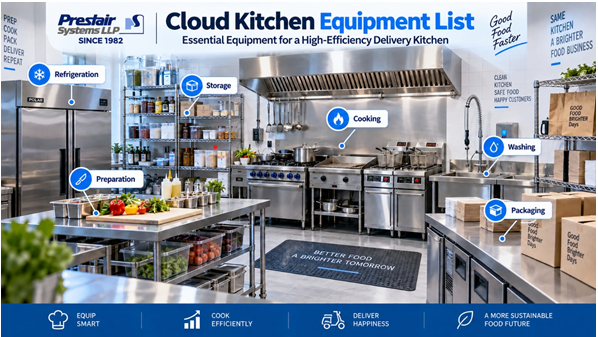
Cloud Kitchen Equipment List: Essential Equipment for a High-Efficiency Delivery Kitchen
The growth of food delivery has changed the way restaurants think about kitchen design. Unlike traditional restaurants, a cloud kitchen does not need a large dining area, elaborate interiors, or customer-facing service space. Its success depends heavily on what happens behind the scenes: efficient food preparation, organized storage, fast cooking, reliable refrigeration, hygienic washing, and smooth order dispatch.
This makes choosing the right cloud kitchen equipment list one of the most important steps when planning a delivery-focused food business.
A properly designed cloud kitchen should allow ingredients, staff, food, packaging, and orders to move through the facility without unnecessary delays. Equipment should therefore be selected according to the menu, expected order volume, available space, utilities, and kitchen workflow.
At Prestair Systems, commercial kitchen equipment, customized fabrication, refrigeration, induction equipment, and kitchen planning can be combined to create professional food-service environments.
1. Why the Right Cloud Kitchen Equipment Matters
Cloud kitchens often operate within smaller spaces than conventional restaurants while handling high order volumes during peak periods.
This means every square metre matters.
The ideal cloud kitchen equipment list should support fast production without creating congestion.
For example, a kitchen specializing in Indian meals will need a different cooking line from a burger, pizza, bakery, Chinese, or multi-brand delivery kitchen.
Before purchasing equipment, businesses should evaluate the menu first.
A useful production flow may follow:
Receiving → Storage → Preparation → Cooking → Finishing → Packaging → Dispatch
If equipment is positioned randomly, staff may repeatedly cross each other’s paths, increasing preparation time.
Commercial kitchen planning helps organize these functions logically.
Production Volume Matters
Equipment should also match expected order volume.
A cooking unit suitable for 50 orders may not be sufficient when the operation grows to several hundred orders per day.
At the same time, oversized equipment can consume unnecessary space, energy, and investment.
Therefore, cloud kitchen planning should balance current requirements with expected future growth.
Learn more about professional commercial kitchen solutions at Prestair Systems.
2. Essential Equipment for a Cloud Kitchen
Although every menu is different, several equipment categories commonly appear in a professional cloud kitchen setup.
Commercial Cooking Equipment
Cooking equipment is the heart of the operation.
Depending on the menu, a cloud kitchen may require induction ranges, commercial burners, griddles, fryers, ovens, boiling units, hot plates, or specialized cooking equipment.
Commercial induction equipment can be especially useful for selected applications where precise temperature control and efficient station design are required.
Preparation Equipment
Preparation stations help keep ingredients organized before cooking begins.
Stainless-steel worktables, cutting stations, sinks, ingredient containers, shelving, and refrigerated preparation counters can all contribute to faster workflow.
Frequently used ingredients should remain close to the relevant cooking station.
Commercial Refrigeration
Reliable refrigeration is essential for storing vegetables, dairy products, sauces, meat, prepared ingredients, beverages, and other temperature-sensitive foods.
Depending on the scale of the operation, a cloud kitchen may use upright refrigerators, under-counter refrigerators, chest freezers, refrigerated preparation units, or cold rooms.
The correct refrigeration system depends on production volume and menu requirements.
Storage Equipment
Dry ingredients, cookware, packaging materials, containers, and supplies require organized storage.
Stainless-steel racks and shelves help keep ingredients accessible while reducing clutter.
Vertical storage can be especially useful in compact cloud kitchens because it makes better use of limited floor space.
Washing Equipment
Hand-washing sinks, utensil washing areas, pot-wash sinks, dishwashing equipment, and drainage should all be considered during planning.
Washing areas should ideally remain separate from food preparation zones to support better organization and hygiene.
3. Packaging and Workflow Are Critical in Delivery Kitchens
A traditional restaurant’s production process often ends when the dish reaches the service counter.
In a cloud kitchen, another important stage follows packaging and dispatch.
The packaging area should therefore be treated as a dedicated workstation.
Prepared food needs to move from cooking or finishing into packaging quickly and in the correct order.
Staff may need space for food containers, bags, labels, cutlery, tissues, condiments, delivery receipts, and order verification.
Poor packaging layout can create bottlenecks even when cooking operations are efficient.
Order Assembly
Multi-item orders require an organized assembly system.
Hot food, cold items, beverages, and desserts may come from different stations and need to reach the packaging area at approximately the same time.
A well-planned kitchen layout reduces unnecessary movement between these stations.
Multi-Brand Cloud Kitchens
Some cloud kitchens operate several virtual restaurant brands from one facility.
In this case, equipment planning becomes even more important.
Different menus may share refrigeration, preparation tables, and selected cooking equipment while requiring separate ingredients or specialized appliances.
Proper zoning helps prevent confusion while allowing equipment to be shared efficiently.
This is where professional commercial kitchen planning can provide significant operational value.
4. How to Build a High-Efficiency Cloud Kitchen
Buying equipment is only one part of creating a successful cloud kitchen.
The equipment must work together as a complete system.
Businesses should evaluate electrical supply, water connections, drainage, exhaust requirements, refrigeration load, storage capacity, cleaning access, staff movement, and maintenance requirements before installation.
Consider Future Growth
A cloud kitchen may begin with one brand and later add additional cuisines or delivery concepts.
Planning some flexibility into the original layout can make expansion easier.
This may include extra electrical capacity, modular equipment, additional storage space, or room for another cooking station.
Choose Equipment Based on Menu
There is no universal cloud kitchen equipment list suitable for every operation.
A pizza kitchen may prioritize ovens and refrigerated preparation counters.
An Indian food kitchen may require heavy-duty cooking equipment, boiling units, induction stations, and large preparation areas.
A bakery-focused cloud kitchen may need mixers, ovens, refrigeration, and cooling racks.
Equipment selection should therefore follow the production process rather than simply copying another restaurant’s setup.
Think About Maintenance
Equipment needs maintenance throughout its working life.
Service technicians should be able to access electrical controls, refrigeration components, drainage connections, and other systems without dismantling large parts of the kitchen.
Allowing proper service clearance during the design stage can make maintenance easier later.
Final Thoughts
The right cloud kitchen equipment list can significantly influence the speed, consistency, organization, and scalability of a delivery-based food business.
Commercial cooking equipment, refrigeration, preparation tables, storage racks, washing systems, packaging stations, and properly planned utilities all need to work together.
Instead of purchasing individual machines first and trying to make them fit afterward, businesses should start with the menu, order volume, workflow, and available space.
Professional planning can then determine the appropriate equipment and layout.
For commercial kitchen equipment, customized fabrication, refrigeration, induction cooking solutions, and kitchen planning, explore Prestair Systems.