

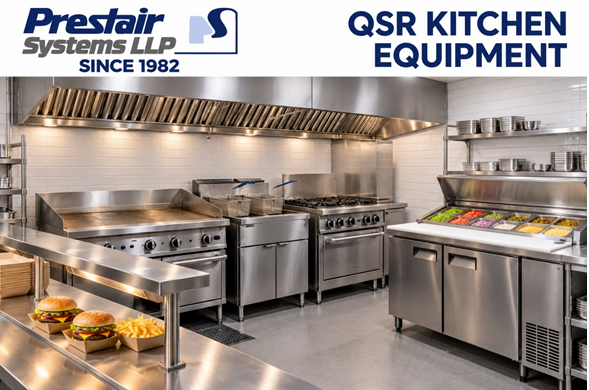
QSR Kitchen Equipment: Essential Machines for Fast & Consistent Food Service
Quick Service Restaurants operate in an environment where speed, consistency, hygiene, and efficient use of space are critical. Customers expect their orders to be prepared quickly while receiving the same taste, portion, temperature, and presentation every time they visit.
Behind this consistency is a carefully planned commercial kitchen equipped with the right QSR kitchen equipment.
Unlike many conventional restaurant kitchens, QSR operations often handle high order volumes within compact spaces. Every piece of equipment therefore needs a clear purpose, from refrigeration and preparation to cooking, holding, washing, and packaging.
Selecting equipment simply by price or size can create problems later. A successful QSR kitchen should be planned according to the menu, expected order volume, service time, available space, utilities, staff movement, and future expansion.
At Prestair Systems LLP, commercial kitchen equipment manufacturing, customized fabrication, kitchen layout planning, and professional food-service solutions can be combined to create efficient restaurant environments.
Explore professional kitchen solutions at Prestair.
1. Why QSR Kitchen Equipment Needs Careful Planning
The central goal of a quick-service kitchen is repeatability.
A customer ordering a product during the morning should receive approximately the same result as a customer ordering it during the evening rush.
To achieve this, the kitchen needs equipment that supports standardized cooking processes.
Faster Service
During peak periods, a QSR may receive many orders within minutes.
The right QSR kitchen equipment helps reduce waiting time by allowing staff to prepare several components simultaneously.
For example, separate preparation, cooking, holding, and assembly stations can keep orders moving without unnecessary delays.
Consistent Cooking
Commercial fryers, griddles, induction units, ovens, and specialized cooking equipment allow kitchen staff to work with more predictable settings.
This can help maintain consistency between different shifts and staff members.
Efficient Staff Movement
Speed depends not only on equipment performance but also on where the equipment is positioned.
A poorly planned kitchen may force employees to repeatedly walk between refrigeration, preparation tables, cooking stations, and packaging areas.
A better workflow may follow:
Storage → Preparation → Cooking → Holding → Assembly → Packaging → Dispatch
When these stages are positioned logically, the kitchen can operate more smoothly.
Better Use of Limited Space
Many quick-service restaurants operate from relatively compact kitchens.
Equipment selection should therefore balance production capacity with available floor area.
Professional kitchen planning can help prevent overcrowding while ensuring important equipment remains easily accessible.
2. Essential QSR Kitchen Equipment for High-Speed Operations
The exact quick service restaurant equipment required depends on the menu.
A burger outlet, pizza QSR, Indian fast-food restaurant, café, fried chicken outlet, or sandwich concept will each require a different combination.
However, several equipment categories are commonly important.
Commercial Cooking Equipment
The cooking line may include:
- Commercial burners
- Griddles
- Deep fryers
- Induction cooktops
- Hot plates
- Ovens
- Sandwich grills
- Chapati or dosa plates
- Specialized cooking units
Equipment should be selected according to the food being prepared rather than simply buying a generic set of machines.
Commercial Refrigeration
Fast service requires ingredients to remain close to where they are used.
QSR kitchens may use upright refrigerators, under-counter refrigeration, freezers, or refrigerated preparation counters.
This helps staff access ingredients quickly while supporting appropriate food storage.
Stainless-Steel Preparation Tables
Preparation tables provide dedicated areas for chopping, portioning, assembling, and organizing ingredients.
Under-counter shelves or storage can also improve space utilization.
Storage Racks
Dry ingredients, packaging, containers, and kitchen supplies need structured storage.
Commercial stainless-steel racks help reduce clutter and make inventory easier for staff to access.
Food Holding Equipment
Some QSR operations require cooked components to remain ready for a short period before assembly.
Appropriate hot or cold holding equipment can help maintain products according to operational requirements.
Washing Equipment
Commercial sinks, pot-wash areas, hand-wash units, and dishwashing equipment are necessary for maintaining an organized kitchen.
The washing section should be located so dirty utensils do not interfere with active food-production areas.
Explore commercial kitchen equipment at Prestair.
3. Designing a QSR Kitchen for Speed and Consistency
Equipment alone does not create a fast kitchen.
The layout needs to support the way staff prepare orders.
Design Around the Menu
The menu should be the starting point for QSR kitchen setup.
If most orders require fried products, fryers and related preparation areas should receive priority.
If the menu is built around griddled foods, sandwiches, or wraps, the cooking line should reflect that workflow.
An Indian quick-service concept may require induction equipment, ranges, griddles, fryers, and specialized holding areas.
Keep Frequently Used Ingredients Close
Chefs should not need to walk across the kitchen every time they need cheese, sauces, vegetables, batter, or other frequently used items.
Strategically positioned refrigeration and ingredient containers can reduce unnecessary movement.
Create a Dedicated Assembly Zone
After cooking, food often needs to move into an assembly or finishing station.
This area may include work surfaces, packaging, sauces, garnishes, and order-checking space.
For delivery-based QSRs, the packaging and dispatch station becomes particularly important.
Separate Clean and Dirty Workflow
Dirty utensils and waste should move away from active food-preparation and assembly areas.
This separation helps improve kitchen organization and reduces unnecessary congestion.
Plan Utilities Early
Electrical connections, gas lines where applicable, ventilation, drainage, water supply, and refrigeration loads need to be considered before equipment installation.
Changing these systems later can increase project cost and delay operations.
4. Building a QSR Kitchen for Long-Term Growth
A QSR kitchen should not only handle today’s order volume.
Successful concepts may increase their menu, add delivery services, operate longer hours, or expand into multiple outlets.
The original kitchen design should therefore allow some flexibility.
Standardization Helps Expansion
For a growing QSR brand, standardized kitchen layouts and equipment can make it easier to maintain consistency across multiple outlets.
When staff encounter similar equipment and workflows at each location, training can become simpler.
Consider Energy Consumption
Kitchen equipment can operate for many hours each day.
Energy consumption therefore becomes an important part of long-term operating cost.
Businesses should evaluate equipment performance, production requirements, and utility infrastructure when choosing between different cooking technologies.
Maintenance Access Matters
Commercial equipment requires regular cleaning and maintenance.
Machines should not be positioned so tightly that technicians cannot access important components.
Allowing appropriate service space during the planning stage can reduce maintenance difficulties later.
Customize Where Necessary
Every kitchen does not fit standard equipment dimensions.
Columns, narrow passages, unusual floor plans, specialized menus, and compact locations may require customized stainless-steel equipment.
Customized fabrication can help make better use of available space while supporting the required workflow.
Final Thoughts
The right QSR kitchen equipment plays a major role in creating fast, consistent, and organized food-service operations.
Cooking appliances, refrigeration, preparation tables, holding equipment, storage racks, washing systems, packaging stations, and utilities should all work together rather than being selected independently.
For new QSR projects, the best approach is to start with the menu and expected production volume, then design the workflow and equipment layout around those requirements.
At Prestair Systems LLP, commercial kitchen equipment, customized fabrication, kitchen layout planning, and food-service solutions can support restaurants, QSRs, hotels, institutional kitchens, and other professional food businesses.
Explore commercial kitchen solutions at Prestair.